

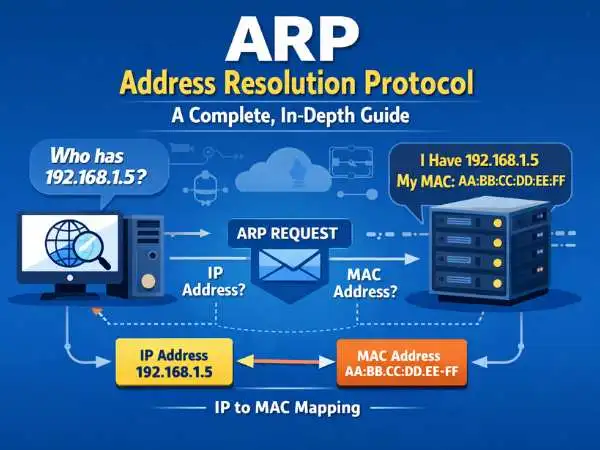

The ARP Address Resolution Protocol sits quietly inside every local network, doing work most users never notice. Each time a device sends data to another device on the same network, ARP steps in to make sure the data reaches the correct physical machine. Without it, even the fastest networks would fail to deliver packets correctly.
Despite being one of the oldest networking protocols still in use, ARP remains essential. Students encounter it early in networking courses, and engineers still troubleshoot ARP issues in real production environments. Understanding ARP is not optional if you want to understand how networks actually function.
This blog explains ARP address resolution protocol explained in a clear and connected way. You’ll learn why ARP exists, how it works internally, what types of ARP are used, how ARP tables function, how ARP spoofing attacks occur, and the best practices for ARP attack prevention.
Address Resolution Protocol in Computer Networks
In computer networks, communication follows a layered model. Each layer solves a specific problem so the entire system remains flexible and scalable.
The network layer identifies devices using IP addresses. These addresses are logical and can change over time. The data link layer, however, works with MAC addresses, which are tied to network hardware.
These two layers cannot communicate directly. This is where the Address Resolution Protocol in computer networks becomes critical. ARP acts as a translator. It allows devices to take a logical IP address and find the physical MAC address required to send an Ethernet frame.
Without ARP, IP-based networking inside a LAN would simply not function.
also read : – Smart Digital Protection: Securing Your Devices While Saving on Software Costs
What Is ARP Address Resolution Protocol
Definition of ARP
The ARP address resolution protocol is a network protocol used to discover the MAC address associated with a given IPv4 address within the same local network.
ARP works automatically in the background. Users do not configure it manually in most environments, yet it runs constantly on every connected device.
Whenever a device wants to communicate with another device on the same LAN, ARP ensures that the correct physical destination is identified before data transmission begins.
ARP Address Resolution Protocol Is Used To
Primary Purpose of ARP
ARP address resolution protocol is used to solve one very specific problem: mapping IP addresses to MAC addresses.
More clearly, ARP is used to:
- Convert IP addresses into MAC addresses
- Enable Ethernet frame delivery
- Allow IP communication within a local network
This conversion happens thousands of times per day on even small networks. Without ARP, switches would have no idea where to forward frames based on IP information alone.
ARP Address Resolution Protocol Is Primarily Used To
ARP address resolution protocol is primarily used to bridge the gap between logical addressing and physical delivery.
IP addresses describe who a device is in the network. MAC addresses describe where it is physically connected. ARP links these two identities together.
This design keeps IP flexible and hardware-independent while still allowing fast, direct communication at the data link layer.
Where ARP Fits in the OSI Model
ARP does not fit neatly into one OSI layer, which often confuses learners.
Functionally:
- ARP supports Layer 3 (Network layer) communication
- ARP messages are transmitted using Layer 2 (Data link layer) frames
Because of this, ARP is sometimes described as a “Layer 2.5” protocol. It exists specifically to serve the boundary between two layers.
How ARP Works (Step-by-Step)
Understanding ARP becomes simple when you follow the process in order.
Step 1: Device Checks the ARP Cache
Before sending any broadcast traffic, a device checks its local ARP table. If the IP-to-MAC mapping already exists and is still valid, communication begins immediately.
This step saves time and reduces network noise.
Step 2: ARP Request Broadcast
If the mapping is missing, the device sends an ARP request as a broadcast message to all devices on the LAN.
The request asks:
“Who has this IP address? Please respond with your MAC address.”
Every device receives the request, but only one responds.
Step 3: ARP Reply
The device that owns the requested IP address sends an ARP reply directly back to the requester.
This reply includes the correct MAC address.
Step 4: ARP Table Update
The requester stores the new mapping in its ARP table for future use. The mapping remains valid for a limited time.
Data transmission continues without interruption.
also read : – How to Delete Google Website History, Why It Matters, and How People Usually Do It on Phone and Android
ARP Address Resolution Protocol Table
What Is an ARP Table
The ARP address resolution protocol table is a local cache stored on each device. It keeps recently learned IP-to-MAC mappings.
This table improves performance by reducing the need for frequent broadcasts and speeding up communication.
Typical ARP table entries include:
- IP address
- MAC address
- Entry type
- Expiration timer
Dynamic ARP Entries
Dynamic ARP entries are created automatically. They expire after a set time to prevent outdated mappings from causing errors.
These entries adapt well to changing network conditions.
Static ARP Entries
Static ARP entries are manually configured and do not expire. They are commonly used in secure environments where critical devices must never accept spoofed ARP responses.
Types of ARP
Standard ARP
Standard ARP maps IPv4 addresses to MAC addresses. This is the most common and widely used form.
Reverse ARP (RARP)
Reverse ARP allows a device to request its IP address based on its MAC address. This method has largely been replaced by newer protocols such as DHCP.
Proxy ARP
Proxy ARP allows one device, often a router, to answer ARP requests on behalf of another device. This can simplify network design in certain scenarios but must be used carefully.
Gratuitous ARP
Gratuitous ARP sends an ARP announcement without being requested. It helps detect IP conflicts and update ARP caches across the network.
ARP Spoofing
What Is ARP Spoofing
ARP spoofing is a network attack where a malicious device sends false ARP replies to associate its MAC address with another device’s IP address.
ARP trusts replies by default, which makes this attack possible.
How ARP Spoofing Works
An attacker repeatedly sends fake ARP replies. Victim devices update their ARP tables with incorrect mappings. As a result, network traffic flows through the attacker’s device instead of the intended destination.
This gives the attacker visibility and control over traffic.
Risks of ARP Spoofing
ARP spoofing can result in:
- Password theft
- Session hijacking
- Data manipulation
- Network disruption
Public and unsecured networks face the highest risk.
Best Practices for ARP Attack Prevention
Use Static ARP Entries
Critical systems benefit from static ARP mappings, which block unauthorized updates.
Enable Dynamic ARP Inspection
Dynamic ARP Inspection verifies ARP packets using trusted sources and drops invalid responses.
Segment Networks
Network segmentation limits the reach of ARP attacks by reducing broadcast domains.
Encrypt Network Traffic
Encryption ensures that even intercepted traffic remains unreadable.
Monitor ARP Tables
Regular monitoring helps detect unusual ARP behavior early.
ARP and IPv6
IPv6 replaces ARP with Neighbor Discovery Protocol (NDP). NDP includes security improvements but still relies on similar principles.
ARP remains essential in IPv4 networks, which are still widely used.
Why ARP Still Matters Today
Many network failures trace back to ARP issues. Duplicate IP addresses, incorrect MAC mappings, and spoofing attacks all involve ARP.
Understanding ARP allows faster troubleshooting and stronger security planning.
also read : – Data and Strategic Business Growth: Leveraging a Reliable Sales Forecast Software for Enterprise Market Expansion
Final Thoughts on ARP Address Resolution Protocol
The ARP Address Resolution Protocol may be invisible to most users, but it is foundational to modern networking. It connects IP logic to physical delivery, allowing local networks to function smoothly. Its simplicity makes it fast, and its weaknesses explain why security controls are necessary.
ARP is old, but it remains essential.
FAQs: ARP Address Resolution Protocol
What is ARP address resolution protocol
It maps IPv4 addresses to MAC addresses within a local network.
ARP address resolution protocol is used to do what
It allows devices to send IP packets using Ethernet frames.
What is an ARP table
A cache that stores IP-to-MAC address mappings.
What are the types of ARP
Standard ARP, Reverse ARP, Proxy ARP, and Gratuitous ARP.
What is ARP spoofing
An attack that redirects traffic using fake ARP messages.
How can ARP attacks be prevented
Using static ARP entries, switch inspection, encryption, and monitoring.